Belarusian FemTech project Stork sets an ambitious goal of one million installs
Forbes Health included Stork in the top 10 «Best Pregnancy Apps of 2025.» The project, which has Belarusian roots, has already reached 500,000 installations and is now aiming for one million. Skeptical experts say: «They’ll repeat the same mistakes.» Will they break through this time?
Forbes Health included Stork in the top 10 «Best Pregnancy Apps of 2025.» The project, which has Belarusian roots, has already reached 500,000 installations and is now aiming for one million. Skeptical experts say: «They’ll repeat the same mistakes.» Will they break through this time?
Another Belarusian FemTech success story?
Flo with its hundreds of millions of downloads and Amma have long been the calling cards of Belarusian FemTech. The success of these projects has spawned a wave of startups in the niche: dozens of teams are trying to follow in their predecessors' footsteps — some are quietly operating, while others have already shut down.
In Cyprus there is reportedly a «Belarusian FemTech hub,» where many founders of similar projects have gathered.
And now there’s a new contender: Stork Pregnancy Tracker, a pregnancy app that recently made Forbes' top 10 and is now aiming to break the one million installation mark.
The only question is: will they achieve what dozens of others couldn’t?
What is Stork and why is it interesting?
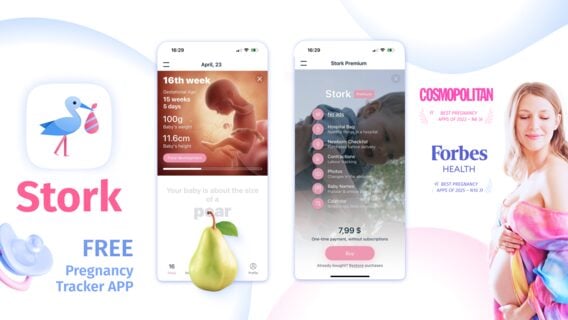
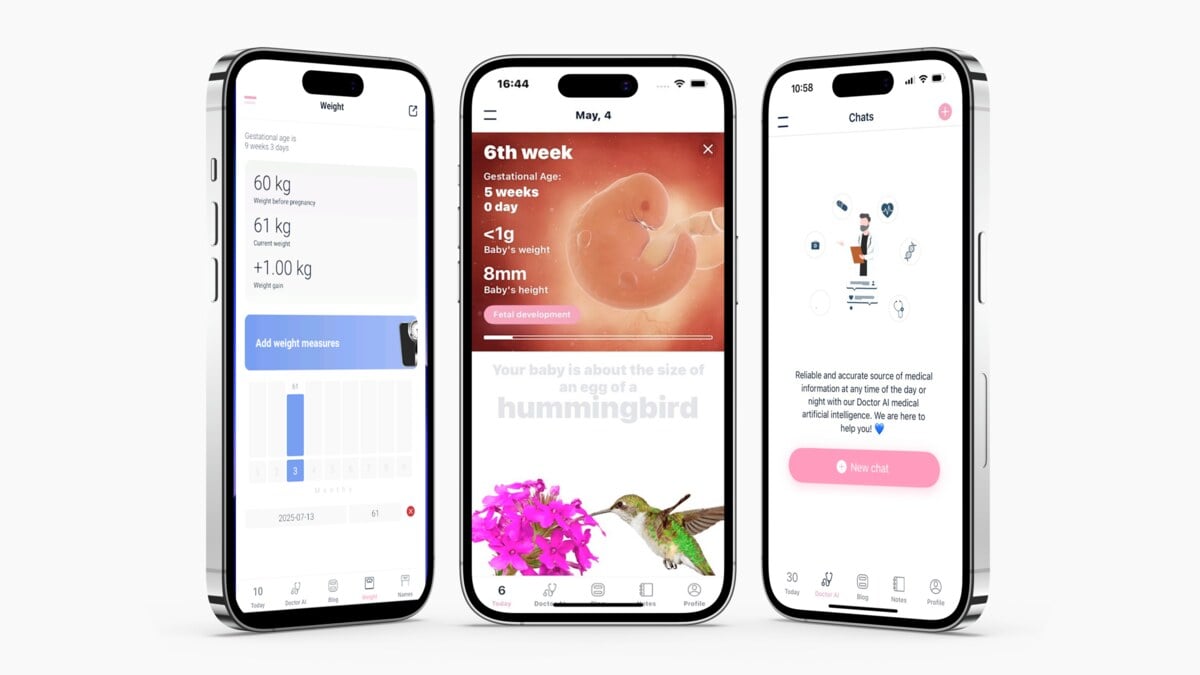
Stork is a mobile app for pregnant women with a complete set of pregnancy tracking features: weekly tracker, hospital and shopping checklists, weight monitoring, contraction counter, and doctor visit calendar. A classic set for this category.
How does the project differ from competitors?
1. AI chatbot — free
A built-in AI consultant that answers medical questions — available in the free basic version. Most competitors offer such functionality only in paid tiers.
Why free? Because user interest is high and the main target markets are Tier-2 and Tier-3 countries (e.g., Argentina, Mexico, Ukraine, Kazakhstan, Nigeria, Indonesia), where smartphone penetration is high but access to regular doctor visits may be limited.
2. Social network inside the app
Pregnant women can communicate with each other, share advice, add photos, like and comment on posts. A kind of «Instagram for pregnant women.» Users return not only for the tracker but also for live communication.
3. One-time payment (not a subscription)
$8 one-time — the premium version is yours forever. All competitors work on subscriptions. For Tier 2/3 markets, this is critical: psychologically, it’s easier to pay once than to give money every month.
The project is already localized into seven languages and is built with React Native — a framework that enables quick updates to be released simultaneously on iOS and Android.
Numbers that make you think
Here’s what Stork has at the moment:
500,000 installations — this milestone was reached in November 2025
High ratings and user reviews in App Store and Google Play
Planning to add up to 70,000 new users by the end of 2025
For comparison: in 2024, the app gained only 20,000 installations all year. This year — already more than 60,000. Growth is happening, that’s a fact.
But there’s a nuance.
One Million — The Rubicon
The Stork team analyzed the FemTech market for pregnancy apps and discovered an interesting thing: the entire market is divided into several categories.
From 0 to 1 million installations — more than 100 apps. This is the «kill zone»: the project exists but typically attracts attention only from users, not investors or partners. Investors don’t look, partners don’t come, there are no serious resources for development.
From 1 to 5 million — about 15 apps. This is already a different level: the project starts to attract investors' attention, opportunities for scaling appear.
Over 5 million — 5-6 players. This is established business: large offices, teams, corporate structures, serious funding.
Crossing the million mark isn’t just a number. It’s a signal to the market: «We survived, users choose us, we’re worthy of attention.» After a million, a different game begins.
The question is: can Stork cross this Rubicon?
What skeptics say
In professional FemTech industry circles, this new Belarusian project in the niche is viewed with slight irony. «They’ll repeat the same mistakes,» comment investors and financiers with whom the Stork team communicates.
And the skepticism is understandable:
The market is saturated. Flo has hundreds of millions of downloads. Amma, BabyCenter, Pregnancy+ and dozens of others — all have already occupied their niches. Breaking through is difficult.
Monetization through one-time payment is a risk. Competitors work on subscriptions for a reason: it’s predictable recurring revenue. A one-time payment might take off, or it might not.
Focus on Tier 2/3 is about volume, not money. Developing countries represent millions of users but low purchasing power. You can gain installations but not earn money.
On the other hand, there are arguments «for»:
Blue Ocean strategy works. While everyone fights for the US and Europe, competition in Tier 2/3 is more moderate, and the need is enormous. In fact, the user base is updated every year.
Growth exists. Doubling annual indicators in half a year is not a coincidence, it’s the result of work.
Making Forbes and Cosmopolitan top lists attracts organic traffic.
High store ratings confirm user interest.
So will it work or not?
Nobody knows.
Stork has advantages: a non-standard business model, focus on non-obvious markets, real achievements and growth. But there’s still a long way from 500,000 to a million, and each next hundred thousand will be more difficult to achieve.
The team doesn’t hide their ambitions and is confident that a million is realistic. Development is positively influenced by: changing registration from Belarus to Lithuania, the arrival of new people and ideas to the team. Investors responded to these developments by raising the app’s valuation to $400,000.
Plans for 2026 include:
Expanding AI functionality to assess user conditions
Integration with Apple HealthKit and Google Fit
Development of telemedicine within the app
Collaboration with medical institutions (e.g., Charité and Erasmus MC).
Skeptics remain unconvinced for now. Meanwhile, users continue downloading the app, using the AI chatbot, and interacting on the in-app social network.
Belarusian FemTech developers have already proven they know how to build global products. The question is whether Flo’s success story will repeat or Stork will join the list of those stuck in the kill zone before reaching a million.
What do you think: will Stork reach a million installations in 2026? Share in the comments!
Belarusian FemTech project Stork sets an ambitious goal of one million installs
Forbes Health included Stork in the top 10 «Best Pregnancy Apps of 2025.» The project, which has Belarusian roots, has already reached 500,000 installations and is now aiming for one million. Skeptical experts say: «They’ll repeat the same mistakes.» Will they break through this time?
"I've dreamed of moving to the U.S. since childhood." This QA engineer spent years and tens of thousands of dollars pursuing a talent visa, but then Trump intervened
Artyom Rusov shares how the immigration-visa freeze has affected his life and why he wants to move to the U.S.
Belarusian IT industry enters stagnation: migration halts as workforce ages and new talent dries up
In 2023, tech migration slowed down, and by the end of 2024, it had virtually stopped. Employment challenges exist both in Belarus and abroad, even for experienced professionals. The industry seems to be in limbo—with no clear growth prospects even considering the potential of the Russian market.
This comes from devby’s annual comprehensive research (1,138 respondents), with data analyzed by Alexander Yurut.
Want to report important news? Write to the Telegram bot
Main events and useful links in our Telegram channel
Обсуждение
Комментируйте без ограничений
Релоцировались? Теперь вы можете комментировать без верификации аккаунта.






Релоцировались? Теперь вы можете комментировать без верификации аккаунта.
В каком месте Amma беларуский? Россияне основатели. Один из универа Плеханова, второй из бауманки