"IT offices have powerful generators. If need be, you can even live there with your family." A story from freezing Kyiv
Here’s what life and work look like in winter after rocket strikes destroyed centralized electricity and heating.


Here’s what life and work look like in winter after rocket strikes destroyed centralized electricity and heating.
Here’s what life and work look like in winter after rocket strikes destroyed centralized electricity and heating.
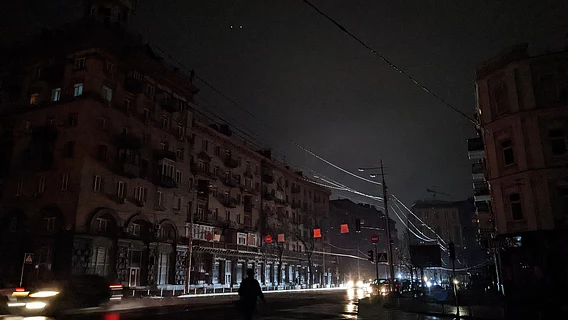
Kyiv’s thermometers have slowly crept upward in the past couple of days. For more than two weeks, nighttime temperatures in Ukraine’s freezing capital, repeatedly deprived of heat and electricity by Russian drones and missiles, have consistently been below −10 °C. Forecasters predict daytime temperatures around 0 °C, possibly slightly above or even slightly above in the coming days. However, this warming trend won’t last long: starting on 30 January, Kyiv is likely to get colder again.
Surprisingly, in a metropolis with radiators burst by freezing, ice in building entrances, non-functional elevators, and windows shattered by drone explosions, people continue to live and work. Among them are Belarusians, including Olga Kuzeeva, formerly a public relations specialist at hoster.by, now a PR manager for technology projects working at a major Ukrainian cloud and AI technology company.
After Russia’s full-scale invasion of Ukraine began, Olga stayed in Kyiv. Two years ago, she shared what her life was like under war conditions. Back then, in February 2024, her building experienced several days without power, stable internet and hot water had returned, and street lighting had been restored to the city after a total blackout.
What does this Belarusian’s life in Kyiv look like now, two more years into the war?

«It’s difficult to describe the situation as it changes several times a week. Just when things seemed to be improving, Russia struck the same energy infrastructure targets again. Instead of four hours of electricity per day, we get only two. Or we go up to three days completely without power.
Compared to some other Kyiv districts, I’ve been (relatively) fortunate. Our building has its own boiler room, so we’re not dependent on central heating. But even with this, we still have heating problems. The uninterruptible power supply (UPS) in the boiler room simply doesn’t have time to charge during brief periods when electricity is available. The boiler room switches periodically between UPS and generator power, affecting the boiler’s output. Apartments are cold, but at least the radiators don’t freeze. In the current conditions, that’s already good.
Overall, the situation doesn’t plunge me into despair. This isn’t Kyiv’s first serious blackout. Everything that could be backed up, reserved, or sorted into different baskets already has. My home now has a collection of power banks, a small gas stove, a spare gas burner, a sleeping bag, quality thermal underwear and clothing, various flashlights, and a large supply of candles. My emergency kit of items hasn’t changed since the war began.»
However, my friends and I joke that we should probably add a whistle to it. Missile strikes too often hit residential buildings. So a practical question is how quickly you’d be found under the rubble—and it’s good to have something to make noise with.
«During extended power outages, my neighbors and I cook food on a grill in the courtyard, warming ourselves with mulled wine. New Year’s string lights still hang in windows—they run on batteries and serve as additional light sources.»
Credit goes to telecom providers and the resilient Ukrainian business spirit: mobile internet and communications remain stable, and delivery of hot food from cafes, water, groceries, and other goods is carried out under any circumstances, regardless of what’s falling on us from the sky.
You might be surprised, but a dog cafe operates without interruption in the neighboring building. Despite everything, people start up a generator every day and prepare fresh food for pets from lamb, beef, chicken, fish, and turkey. Everything is always fresh and available.
«Yes, it’s all incredibly difficult. Living and working under these conditions is abnormal. But we adhere to the principle: better a winter with generators than a lifetime with degenerators.
Psychologically, I’ve already adapted. Coming to the office in wrinkled clothes, without makeup, or with unwashed hair isn’t a problem for me. And yes, I choose to work in the office. It makes my life more structured amid the chaos of war.
Since 2022, most companies have become a kind of 'Points of Invincibility' for their employees. At minimum, they have powerful generators and the ability to charge all your power banks. We also have a hot shower, a washing machine, and even accommodations for staying overnight. There’s also a spacious kitchen and a buffet with hot food. I haven’t had to use all this yet, but I know that in an emergency, I can simply grab my clothes and dog and head to the office.
For emotional relief, there’s a sports room that available without strict schedules. At any moment during work hours, you can get up and go to exercise your mental balance. In any weather and with any lighting, a fitness and yoga instructor shows up.
The office is equipped to serve as temporary housing for employees' families as well. There’s even a separate office in case employees' relatives need a free coworking space.
No one in the company is considering relocation. In the fifth year of the war, those working here are people who have made a conscious decision to remain in Ukraine.»
Most Kyiv residents and many people in the Kyiv region were left without electricity, heating, and water for several days following another massive Russian missile and drone strike on the night of January 9, 2026. This coincided with a sharp cold snap, during which temperatures in Ukraine’s capital region fell as low as −20 °C. Despite the severe frost, Russian attacks on Ukraine’s energy system, including Kyiv, continued.
Other Ukrainian megacities also faced blackouts caused by Russian strikes in January: Dnipro, Kharkiv, Odesa, and Zaporizhzhia. Due to Russia’s deliberate destruction of Ukraine’s energy infrastructure during severe frosts, millions of people, including children and the elderly, have been left in terrible cold for weeks. By analogy with the Holodomor (the mass famine in Ukraine in 1932-1933 organized by Soviet leadership), these events have been dubbed «Kholodomor» (Cold-induced death).