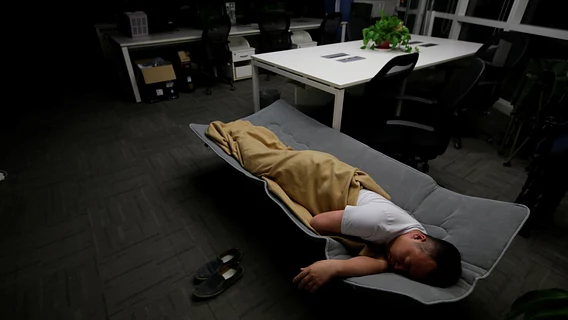
"This isn't 996 — it's worse": 16-hour shifts are becoming the norm at AI startups
In AI startups, 12–16-hour workdays with few or no weekends are becoming the norm. Employees talk about pressure, fear of layoffs, and a race for survival — and believe this model could spread throughout the economy.
In AI startups, 12–16-hour workdays with few or no weekends are becoming the norm. Employees talk about pressure, fear of layoffs, and a race for survival — and believe this model could spread throughout the economy.
Mythril AI co-founder Sanju Lokuhitige told The Guardian that he works seven days a week, about 12 hours a day. «Sometimes I code all day; I have no work-life balance,» he said. He added that even on Sundays many people in cafés are working on laptops.
Another employee described living in a two-bedroom apartment where he and his roommates — who were the startup’s founders — worked from 9 a.m. until late at night, taking only brief breaks for food delivery and sleep. He called the situation «terrible» and noted that it is no longer just about China’s «996» work culture (9 a.m. to 9 p.m., six days a week) but about 16-hour shifts.
While hustle culture has always been part of the startup environment, in the AI era, it has reached new heights. The excitement about technological breakthroughs combines with growing anxiety. Employees are simultaneously creating tools that could replace their own jobs while wondering if there will be a place for them in the future they are building, The Guardian notes.
According to data from RationalFX, tech companies laid off roughly 250,000 employees worldwide in 2025. In many cases, AI was cited as a contributing factor in those restructurings. Leaders of major companies — including Mark Zuckerberg and Elon Musk — have openly discussed how AI could replace some junior and mid-level engineers and have pushed for greater «efficiency» and «resilience» from teams.
«If you were a software engineer five years ago, you could dictate terms,» says executive coach Mike Robbins, who has worked with Google, Microsoft and Salesforce. He added that the power balance has shifted, and companies have become more demanding because they are less afraid of losing staff.
Entry-level professionals are particularly vulnerable. Data from Indeed Hiring Lab shows that entry-level tech positions have fallen by one-third since 2022, while demand has risen for specialists with five or more years' experience. «Junior developers aren’t being hired as often,» Lokuhitige said. To get a job, you need to «do something cool»: launch a product or demonstrate notable results.
Mintlify engineer Kyle Finken acknowledges that many are asking, «Will I have a job in three years?» He adds that this period is among the most creative and productive the industry has seen, and many people work overtime not only because of pressure but also because of their passion for the technology.
But economists warn that what’s happening may be just the beginning of a broader transformation. A study by Stanford University documented a «significant reduction in employment among early-career workers» in fields affected by AI, describing those sectors as a «canary in the coal mine» for the wider economy. Anthropic CEO Dario Amodei has suggested that within five years AI could eliminate up to half of entry-level office positions.
International Monetary Fund managing director Kristalina Georgieva compared the effect of AI to a «tsunami hitting the labour market,» noting that in some developed economies up to 60% of jobs could be transformed or disappear.